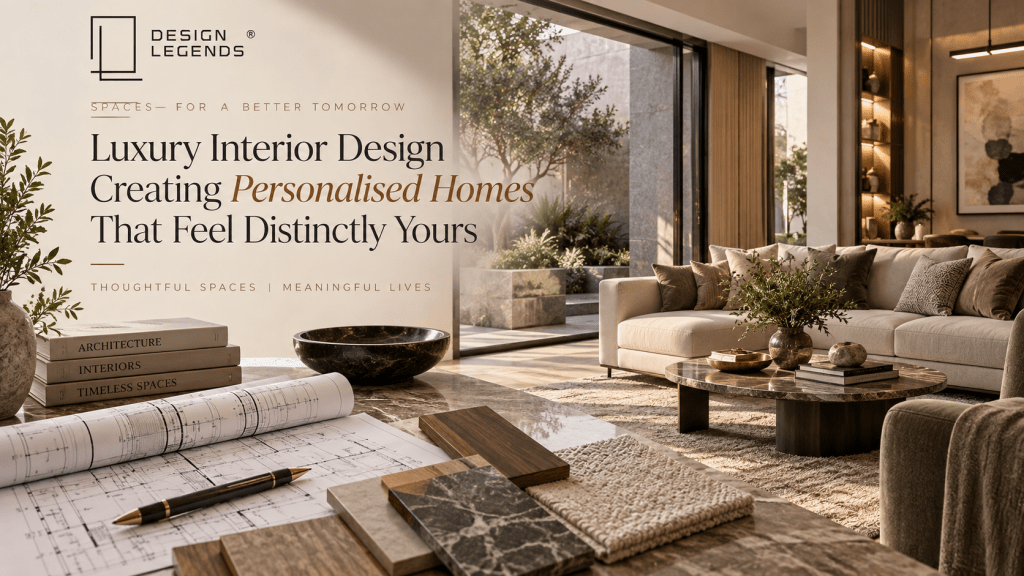
A luxurious home is not defined by how much is spent on it. It is defined by how thoughtfully every part of the space comes together.
The best luxury interior design goes beyond expensive marble, statement chandeliers, designer furniture, and decorative finishes. It considers how a family lives, how spaces connect, how natural light enters the home, how materials will age, where storage is required, and how the interiors should feel years after the project is complete.
This is also why personalised home designs have become increasingly important. Homeowners are moving away from interiors that look copied from catalogs or social media references. They want homes that reflect their lifestyle, preferences, routines, and individual sense of style.
At Design Legends, luxury interiors are approached through planning, material selection, lighting, custom detailing, spatial balance, and a clear understanding of the people who will ultimately live in the space.
The result should not simply be a beautiful property.
It should be a home that feels unmistakably personal.
What Does Luxury Interior Design Really Mean?
The meaning of luxury has changed.
There was a time when luxury interiors were commonly associated with visual excess. Elaborate ceilings, ornate furniture, glossy finishes, oversized decorative elements, and expensive materials were often used as obvious indicators of luxury.
Contemporary luxury interior design can be much more considered.
Luxury can be found in a beautifully planned living room where furniture fits the architecture perfectly. It can appear in a custom wardrobe designed around the owner’s requirements. It can be seen in the way two materials meet cleanly, how daylight falls across a textured wall, or how lighting changes the atmosphere of a room after sunset.
In other words, luxury is increasingly about quality of experience.
A home should feel effortless to use while remaining visually refined.
Achieving that balance requires much more than decoration. It requires careful decisions about planning, proportion, materials, furniture, lighting, storage, craftsmanship, and execution.
Why Personalisation Has Become Central to Luxury Homes
Two homes may have the same floor area and budget but require completely different interiors.
One family may entertain frequently and need generous social spaces. Another may prefer privacy and require separate family and formal areas.
Some homeowners want open kitchens connected to dining spaces. Others need enclosed kitchens because of their cooking habits.
A family with young children may prioritise durable surfaces, accessible storage, and flexible spaces. A multigenerational family may require greater accessibility, privacy, and distinctly planned zones for different age groups.
This is where personalised home designs become essential.
Instead of forcing a predetermined aesthetic onto the property, the design begins with the people.
Questions such as these become important:
Who lives in the house?
How does the family spend its time?
How frequently are guests entertained?
What needs to be stored?
Which spaces are used most frequently?
Does the family prefer formal or relaxed living?
What degree of maintenance is practical?
Which materials and colours feel natural to the homeowners?
What should the home feel like five or ten years from now?
The answers establish a design direction that is specific to the client rather than generic.
Luxury Interior Design Begins with Space Planning
Before selecting marble, fabrics, veneers, lighting fixtures, or furniture, the layout needs to work.
Space planning is one of the most important foundations of luxury interior design.
It determines how comfortably people move through the home and how effectively every room performs its intended function.
A well-planned residence considers circulation, furniture dimensions, privacy, natural light, storage, visual connections, room relationships, and clearances.
Consider a luxury living room.
A large sofa may look impressive in isolation, but if its proportions are wrong for the room, circulation can become uncomfortable. Similarly, a beautiful dining table can become inconvenient if there is insufficient clearance around the chairs.
Luxury is therefore not about fitting more into a space.
It is about giving every element enough room to work properly.
This planning discipline becomes even more important in large residences where multiple lounges, bedrooms, entertainment areas, dressing rooms, kitchens, terraces, and circulation spaces need to feel connected rather than fragmented.
Creating a Home Around the Client’s Lifestyle
A successful home should support everyday routines without requiring its occupants to constantly adjust to the design.
That principle is fundamental to personalised home designs.
Take the kitchen as an example.
Its design should respond to how frequently the family cooks, who uses the kitchen, what appliances are required, how groceries are stored, whether there is additional utility space, and how the kitchen connects with dining and service areas.
Bedrooms require another set of considerations.
Wardrobe capacity, bedside access, lighting controls, dressing areas, seating, privacy, bathroom connections, and storage should all be planned around the occupants.
The same applies to living spaces.
A formal drawing room designed primarily for guests has different requirements from an everyday family lounge.
When these distinctions are understood early, the home becomes significantly more intuitive.
Material Selection Defines the Experience
Materials are one of the most visible aspects of luxury interiors, but choosing premium materials alone does not guarantee a premium result.
The relationship between materials matters just as much.
Natural stone, timber, metal, glass, fabric, leather, textured plaster, veneer, and other finishes all have different visual and tactile qualities.
They also respond differently to light, moisture, wear, cleaning, and time.
Good luxury interior design creates a controlled material palette rather than filling every surface with a different finish.
For example, a natural stone floor might establish the foundation of a room while timber introduces visual depth. Upholstered furniture can soften the composition, while carefully placed metal details provide definition.
The objective is not to make every material compete for attention.
It is to create hierarchy.
Some materials should establish the background. Others should become focal points.
This restraint often separates sophisticated interiors from overdesigned ones.
Custom Furniture Makes Luxury More Personal
Furniture has a major influence on how an interior functions and feels.
In personalised home designs, custom furniture provides an opportunity to respond directly to the architecture and the people using the space.
Instead of choosing furniture simply because it looks attractive in a showroom, pieces can be designed according to exact room dimensions, seating requirements, storage needs, material preferences, and visual proportions.
A console can be developed specifically for an entrance wall.
A dining table can respond to the number of people regularly using it.
A bed can be designed around the dimensions and visual scale of the bedroom.
A media unit can integrate storage, equipment, lighting, and display areas into a single composition.
Custom furniture also allows materials used elsewhere in the interior to continue through individual pieces, creating greater visual consistency.
The result feels integrated rather than assembled.
Lighting Is a Fundamental Part of Luxury Interior Design
Lighting can transform the perception of an interior.
The same materials, furniture, and colours can feel completely different depending on how they are illuminated.
For this reason, lighting should be planned alongside the interiors rather than added at the end.
Effective luxury interior design usually combines several lighting layers.
Ambient lighting provides general illumination.
Task lighting supports specific activities such as reading, cooking, working, or grooming.
Accent lighting can highlight artwork, architectural surfaces, cabinetry, niches, sculptures, or material textures.
Decorative lighting can become an object of interest in itself.
The relationship between these layers allows a home to change throughout the day.
A living room that feels bright and open during daytime can become quieter and more intimate in the evening through carefully controlled lighting.
This flexibility contributes directly to the experience of luxury.
Natural Light Should Influence the Design
Artificial lighting is only part of the equation.
Natural light can determine furniture placement, material selection, colour perception, curtain design, and the overall atmosphere of a room.
A well-positioned seating area beside a large window can become more valuable than an elaborate decorative feature.
A dining space oriented toward a garden can make everyday meals feel more connected to the outdoors.
Materials can also respond differently depending on daylight conditions. Stone reveals natural variations. Timber gains depth. Textured surfaces become more visible as sunlight moves across them.
For personalised home designs, understanding how each family uses spaces throughout the day can help determine where natural light should be prioritised.
Storage Is Part of Luxury
Clutter can undermine even the most expensive interior.
That makes storage an essential part of luxury residential planning.
Instead of adding cabinets after the main design is complete, storage should be integrated into the architecture wherever possible.
Wardrobes, kitchen cabinetry, entertainment units, utility storage, linen cabinets, display niches, bars, study units, shoe storage, and concealed service areas can all be planned from the beginning.
The best storage is not necessarily invisible.
It simply feels intentional.
For example, a floor-to-ceiling wardrobe can become an architectural surface rather than appearing like an additional piece of furniture.
A media wall can combine display, technology, and concealed storage.
A kitchen island can provide preparation space while incorporating drawers and cabinets.
These solutions allow luxury interior design to remain visually composed while supporting real everyday requirements.
Luxury Should Be Felt in the Details
Large design decisions establish the overall direction of a home, but smaller details often determine how refined the final result feels.
Cabinet alignments, hardware selection, shadow gaps, skirting details, door proportions, curtain tracks, electrical controls, furniture joints, stone edges, metal profiles, ceiling junctions, and lighting placement all contribute to the finished interior.
Individually, these details may appear minor.
Collectively, they define the quality of execution.
This is why documentation and site coordination matter.
A strong design concept can lose much of its impact if materials are installed incorrectly or details are improvised during execution.
True luxury depends on maintaining design intent from concept through completion.
Designing Luxury That Does Not Become Dated
Trends are useful sources of inspiration, but a home designed entirely around current trends can age quickly.
Timeless luxury interior design requires a stronger foundation.
Proportion, material quality, functionality, craftsmanship, natural light, and spatial planning generally remain relevant much longer than fashionable colours or decorative motifs.
This does not mean every home should look neutral or conservative.
Personality is important.
The difference lies in deciding where to make a statement.
Permanent architectural elements can remain more restrained, while artwork, loose furniture, rugs, accessories, and soft furnishings provide opportunities for experimentation.
Over time, these elements can evolve without requiring the entire interior to be redesigned.
This approach allows a home to remain current while retaining its original identity.
Connecting Architecture and Interior Design
Interior design becomes more effective when it is considered alongside architecture.
Window positions influence furniture layouts.
Ceiling heights influence lighting.
Structural columns can affect room planning.
Staircases can become major visual features.
Door locations influence circulation.
Outdoor spaces can change how internal living areas are oriented.
When architecture and interiors are developed with a shared vision, fewer compromises are required later.
For custom residences, this integration is particularly valuable because personalised home designs can begin before the building is complete.
Rather than adapting the interiors to architectural decisions that have already been fixed, both can support each other from the beginning.
What Makes a Luxury Home Feel Personal?
Personalisation does not require placing photographs or initials throughout the house.
It comes from deeper design decisions.
Perhaps the family enjoys hosting large dinners, so the dining area becomes a central social space.
Perhaps someone is an avid reader, requiring a dedicated library or reading corner.
A homeowner may collect art and need walls, lighting, and circulation planned around specific pieces.
Another family may place significant importance on a prayer room and want it integrated meaningfully into the architecture.
Someone working from home may require a private office that feels connected to the residence without compromising concentration.
These decisions create identity.
They are what separate personalised home designs from interiors developed according to a standard template.
Why Restraint Matters in Luxury Interior Design
One of the easiest mistakes to make in luxury interiors is trying to make every element a statement.
If the flooring is dramatic, walls are heavily detailed, furniture is oversized, ceilings are elaborate, lighting is decorative, and accessories are abundant, the individual elements begin competing with one another.
Visual luxury requires hierarchy.
A room needs moments of emphasis as well as quieter areas.
A striking stone wall may need simple furniture around it.
A sculptural chandelier may work best against a restrained ceiling.
Detailed furniture can be balanced with calmer architectural surfaces.
Restraint allows important elements to have greater impact.
Luxury is not determined by how many premium features can be added to a room.
It is determined by how intelligently they are composed.
The Design Legends Approach to Luxury Interiors
Design Legends works across architecture, luxury residences, interiors, commercial spaces, hospitality, and other design categories, allowing interior decisions to be considered within a broader architectural context.
For luxury interiors, the studio’s approach focuses on material curation, spatial sensibility, custom detailing, bespoke furniture and layered lighting. The objective is to create spaces that are not simply styled for appearance but planned around everyday routines and long-term use.
This thinking is particularly relevant to homeowners looking for personalised home designs rather than standardised interiors.
Every family brings different expectations to a project.
The design should respond accordingly.
Choosing the Right Luxury Interior Designer
Before selecting a designer for a luxury residence, homeowners should look beyond photographs.
A strong portfolio is important, but so are the processes behind the finished spaces.
Consider whether the designer understands spatial planning as well as aesthetics.
Ask how materials are selected.
Understand how custom furniture is developed.
Review the level of documentation provided.
Discuss how site coordination and execution are handled.
Determine how the team understands the client’s lifestyle before developing the design.
Most importantly, look for a design approach capable of adapting to the client rather than repeating the same visual formula from project to project.
A luxury residence represents a substantial investment.
The design process should therefore create value not only visually, but functionally and over the long term.
Conclusion
The most successful luxury interior design is not defined by excess.
It is defined by clarity.
Every room should have a purpose. Every material should have a reason for being there. Furniture should respond to the scale of the architecture. Lighting should support different moments throughout the day. Storage should make everyday life easier. Details should reinforce the overall design rather than distract from it.
Most importantly, the home should reflect its occupants.
That is the real value of personalised home designs.
Instead of creating another visually impressive interior that could belong to anyone, thoughtful design creates a home connected to a particular family, lifestyle, and way of living.
For homeowners looking to create a refined residence with a distinct identity, Design Legends brings together architecture, spatial planning, materials, lighting, custom detailing, and interior design to develop spaces intended to remain relevant beyond short-lived trends.
A luxury home should look exceptional.
But the real measure of its design is how naturally it feels like yours.
Frequently Asked Questions
What is luxury interior design?
Luxury interior design is a comprehensive approach to creating refined spaces through thoughtful planning, premium materials, custom detailing, furniture, lighting, craftsmanship, and careful execution. Modern luxury focuses as much on comfort and functionality as visual quality.
What are personalised home designs?
Personalised home designs are created around the specific lifestyle, preferences, routines, functional requirements, and aesthetic expectations of the people living in the property rather than following a standard design template.
Is luxury interior design only suitable for large homes?
No. Luxury depends on quality of planning, materials, detailing, and execution rather than square footage alone. A carefully designed apartment can provide a more luxurious experience than a much larger but poorly planned residence.
How can I make my luxury home feel timeless?
Prioritise strong spatial planning, appropriate proportions, quality materials, functional layouts, considered lighting, and durable permanent finishes. More trend-driven elements can be introduced through artwork, accessories, rugs, and loose furniture that are easier to update later.
Why is custom furniture important in luxury interiors?
Custom furniture can be designed according to the exact dimensions, functional requirements, material palette, and architectural character of a room. This creates a more integrated result than selecting unrelated furniture pieces solely from showrooms.
Why should architecture and interiors be planned together?
Architectural decisions such as windows, doors, ceiling heights, structural elements, circulation, and room proportions directly affect interior planning. Coordinating both disciplines early can create a more cohesive home and reduce compromises during execution.
How does Design Legends approach luxury interior design?
Design Legends combines spatial planning, material curation, custom detailing, furniture, lighting, and architectural understanding to create interiors developed around the people using them. The focus is on spaces that balance visual refinement with functionality and long-term relevance.
Planning a Luxury Home?
If you are planning a new residence or redesigning an existing property, work with a design team that understands both the visual and functional sides of luxury.
Connect with Design Legends to explore luxury interior design and personalised home designs developed around your architecture, lifestyle, and long-term vision.